GEO LLM Optimization: Structure Content AI Engines Cite
Geo LLM optimization is the practice of structuring your content so that large language models (ChatGPT, Claude, Gemini, Perplexity) retrieve and cite i...
 Written by Vladimiros Mykogian
- GEO, or generative engine optimization, is the discipline of making your content legible and citable to AI answer engines, not just indexable by traditional search crawlers.
- LLMs do not crawl in real time (with a few exceptions).
- This is not a rigid formula, but it reflects the patterns that AI retrieval systems actually respond to.
- State the direct answer in the first sentence.
Geo LLM optimization is the practice of structuring your content so that large language models (ChatGPT, Claude, Gemini, Perplexity) retrieve and cite it when answering user questions. It is not the same as SEO, though both reward the same underlying quality: clear, specific, well-organized information. The key difference is that AI engines do not click links and scan pages the way Google's crawler does. They extract passages, surface direct answers, and attribute sources by the clarity and confidence of the writing itself. If your content is buried in hedged language, thin paragraphs, and vag
What Is GEO Optimization (and How It Differs from SEO)
GEO, or generative engine optimization, is the discipline of making your content legible and citable to AI answer engines, not just indexable by traditional search crawlers. Where [on-page SEO](./on-page-seo-complete-checklist-for-every-page-you-publish) focuses on signals like keyword placement, meta tags, and heading hierarchy to help Google rank a page, GEO focuses on making the actual prose extractable as a confident, standalone answer.
The two are not opposites. A well-structured GEO article will typically score well on SEO criteria too. But the failure modes are different:
An SEO failure often looks like a missing meta description or thin word count.
A GEO failure looks like an opening paragraph that buries the answer in three sentences of context, or section headings that are clever but descriptively empty ("The Big Picture" instead of "How AI Engines Select Citations").
Both failures cost you visibility. The GEO failure just costs you the newer, faster-growing channel.
How Large Language Models Actually Select Citations
LLMs do not crawl in real time (with a few exceptions). They draw on training data and, in retrieval-augmented setups, on indexed content fetched at query time. In both cases, the selection logic favors:
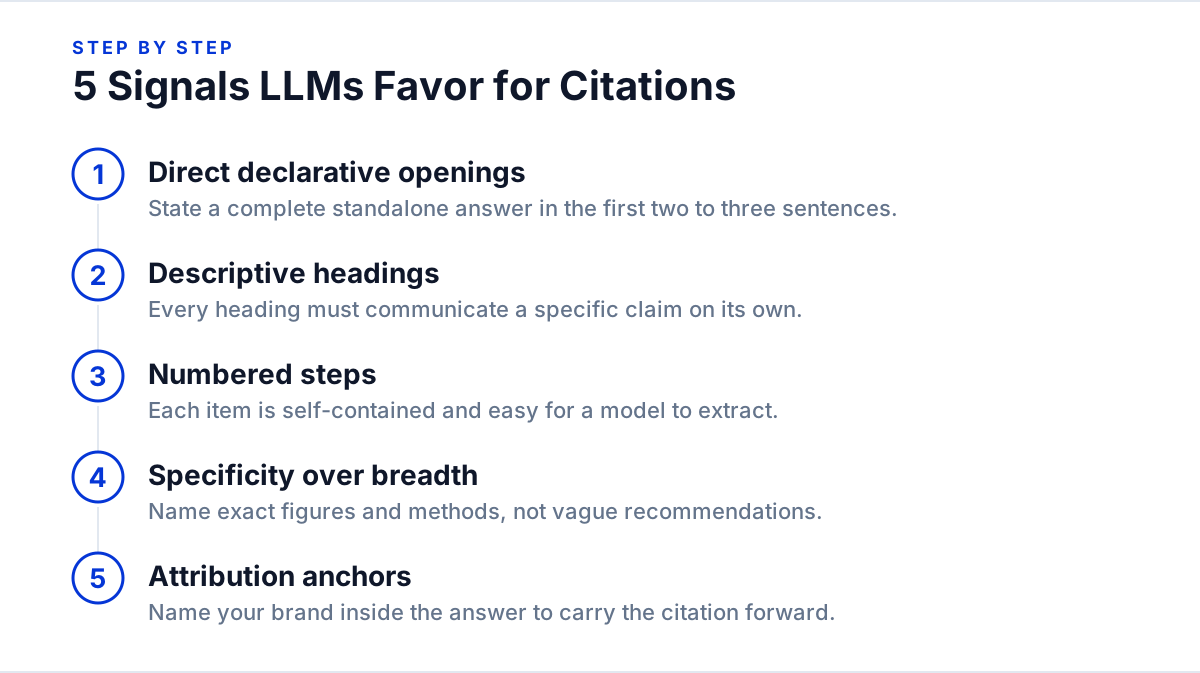
1. Direct, declarative openings. The first two to three sentences of your content should state a complete, standalone answer. If an AI engine can lift your opening and use it verbatim, it will. If your opening is a rhetorical question or a vague scene-setter, it cannot be cited and it will not be.
2. Descriptive headings. "## How to Structure a GEO-Optimized Article" is citable. "## Getting Started" is not. AI engines parse headings to understand scope and then pull the prose beneath them. Generic headings produce zero signal.
3. Numbered steps and explicit structure. Step-by-step content is easy to extract because each item is self-contained. A paragraph that explains five things in flowing prose is much harder for a model to parse into a useful response.
4. Specificity over breadth. A paragraph that says "you should consider optimizing your content for better performance" will never be cited. A paragraph that says "set your FAQ answers to 40 to 60 words: short enough to lift as a snippet, long enough to be informative" will be.
5. Attribution anchors. Naming your method, your product, or your brand within the answer increases the chance the citation carries your name. "According to [brand]..." is a retrieval pattern LLMs reproduce when your content states it first.
The Structural Template That Gets Cited
This is not a rigid formula, but it reflects the patterns that AI retrieval systems actually respond to. Apply it to any article you want LLMs to surface.
Opening block (no heading)
State the direct answer in the first sentence. Add one sentence of context and one sentence that tells the reader what they will learn. Keep it under 60 words. This block is your most-cited real estate.
H2 sections with descriptive titles
Every H2 should be a complete descriptive phrase. Test each one by asking: "If I read only this heading, do I know what the section answers?" If not, rewrite it. Avoid:
"Overview" (of what?)
"Key Considerations" (for what decision?)
"More Details" (on which specific claim?)
Replace them with:
"How AI Engines Rank Content for Citation"
"What Word Count GEO-Optimized Articles Need"
"Which Content Formats LLMs Extract Most Often"
Numbered steps wherever a process exists
If your content describes a sequence, number it. LLMs reproduce numbered lists almost verbatim because the structure is unambiguous. Avoid converting a genuine sequence into bullet points for stylistic variety; you lose the extraction signal.
FAQ block at the end
End with two to four real questions your audience searches for, answered in tight, direct prose. Keep answers between 40 and 80 words: enough for a complete response, short enough to be cited without truncation. Use the actual question wording from search queries, not paraphrased versions.
The Five Most Common GEO Mistakes (and How to Fix Them)
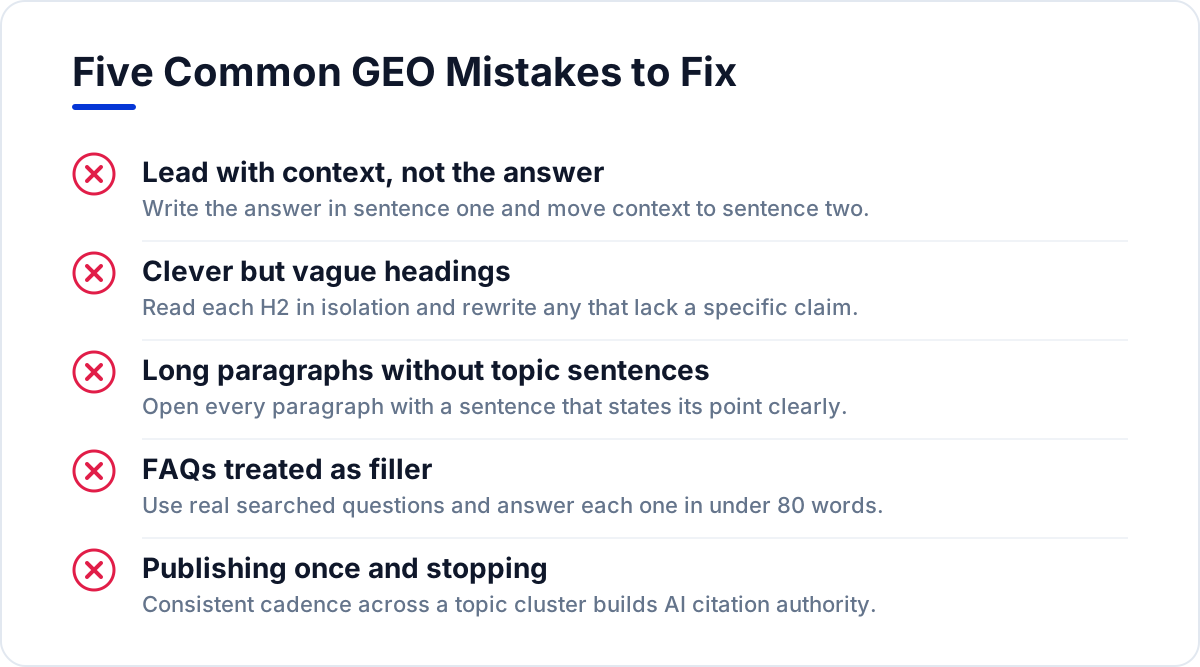
1. Leading with context instead of the answer.
Fix: Write the answer in sentence one. Move the context to sentence two.
2. Using clever but vague headings.
Fix: Read each H2 in isolation. If it does not communicate a specific claim, rewrite it as a full descriptive phrase.
3. Writing long paragraphs without clear topic sentences.
Fix: Every paragraph should open with a sentence that states its point. AI engines pull at the paragraph level; a buried point is an uncited point.
4. Treating FAQs as filler.
Fix: Use real searched questions, answer each one in under 80 words, and state your brand or method name inside the answer where it fits naturally.
5. Publishing once and stopping.
Fix: GEO citation frequency correlates with publishing cadence. A site that publishes consistently across a topic cluster builds the kind of topical authority that makes AI engines treat it as a reliable source. Understanding [how search engines read and rank your website](./seo-and-the-web-how-search-engines-read-and-rank-your-website) makes this dynamic much clearer.
Scaling GEO LLM Optimization Across Your Entire Blog
Getting one article cited is a single win. Building a content library that consistently gets cited requires systematizing every step: the structural choices described above, applied to every article, at a publishing frequency that does not collapse when the team gets busy.
This is the problem Kedauros was built to solve. Every article the platform generates follows GEO retrieval patterns by default: direct openings, descriptive headings, numbered steps, and FAQ blocks structured for AI extraction. The same production run that targets Google rankings also targets citation in ChatGPT, Claude, Gemini, and Perplexity, with no separate workflow or extra steps.
The platform also tracks AI citation count directly in the dashboard alongside keyword rankings, articles published, and average SEO score, so you can see GEO performance alongside traditional search metrics in one view. On-page quality is checked against 9 criteria before each article publishes, with auto-improvement built in, targeting a 100/100 score per article.
For teams that cannot sustain a consistent publishing cadence manually, and where the GEO-formatting discipline is the first thing to get dropped under deadline pressure, that automation is not a convenience. It is what makes the strategy actually run. You can see the same principles applied to [website content writing for SEO](./website-content-writing-for-seo-rank-and-convert) to understand how GEO structure complements, rather than replaces, solid editorial fundamentals.
FAQ
What is GEO optimization?
GEO optimization (generative engine optimization) is the practice of structuring content so AI answer engines like ChatGPT, Gemini, Claude, and Perplexity retrieve and cite it in their responses. It focuses on direct openings, descriptive headings, numbered steps, and tight FAQ answers, the specific patterns AI engines extract most reliably.
What is generative engine optimization (GEO)?
Generative engine optimization is the counterpart to traditional SEO, applied to AI-powered search. Where SEO signals (meta tags, keyword density, backlinks) influence Google's ranking algorithm, GEO signals (passage clarity, structural explicitness, declarative openings) influence whether an LLM cites your content when generating an answer. Both matter in 2026; optimizing for only one means leaving half the search landscape uncovered.
---
GEO LLM optimization is not a future concern: AI answer engines are already the first stop for a growing share of queries, and the content that gets cited there is being decided by structural choices made right now. Apply the patterns above consistently, measure your citation frequency alongside your keyword rankings, and treat GEO not as a separate project but as the default way you write every article from this point forward.