Generative Engine Optimization GEO Services: How to Choose
Generative engine optimization GEO services help your content get cited by AI answer engines like ChatGPT, Claude, and Gemini, not just ranked on Google...
 Written by Vladimiros Mykogian
- GEO is the practice of structuring and writing content so that AI language models cite it as a source when answering user questions.
- "GEO optimization" is not a single tactic.
- Every article should open with a direct, quotable answer to the core question.
- AI models favor sources that cover a topic in depth across multiple pieces.
Generative engine optimization GEO services help your content get cited by AI answer engines like ChatGPT, Claude, and Gemini, not just ranked on Google. If you are evaluating generative engine optimization GEO services right now, the most important thing to understand is this: most vendors are still repacking traditional SEO under a new label. This guide will help you tell the difference and make a smart choice.
What Is Generative Engine Optimization (GEO)?
GEO is the practice of structuring and writing content so that AI language models cite it as a source when answering user questions. Where traditional SEO aims to appear in Google's ten blue links, GEO targets the answer itself: the paragraph ChatGPT quotes, the source Perplexity links, the snippet Gemini surfaces in an AI Overview.
The mechanics differ from classic SEO in a few concrete ways:
Authority signals matter differently. AI models weight topical depth and factual clarity heavily. A single thorough article on a narrow topic can outperform a thin content library.
Sentence-level clarity wins. Models pull quotable, self-contained sentences. If your opening paragraph directly answers a question, it is far more likely to be cited than a paragraph that buries the answer in the third sentence.
Structured context beats keyword density. Headers, numbered steps, and defined terms help models parse and attribute your content correctly.
GEO and SEO overlap significantly. A well-structured, authoritative article that answers real questions tends to perform in both channels. The difference is in what you optimize for and how you measure success. For a deeper grounding in how large language models evaluate and surface content, the Google Search Central documentation on AI Overviews is a useful reference point.
What GEO Optimization Actually Involves
"GEO optimization" is not a single tactic. It is a set of content and structural decisions made at every stage of production. Here is what that looks like in practice:
Content structure built for AI parsing
Every article should open with a direct, quotable answer to the core question. Think of the first two to three sentences as a potential citation: if a model lifted them verbatim, would they be accurate and useful? If not, rewrite them.
Use descriptive H2 and H3 headings. Models use headings to understand topic scope. Vague headings like "More Information" or "Other Things to Know" are invisible to both search engines and AI systems.
Consistent brand voice and factual accuracy
Models are more likely to cite content that reads as authoritative and consistent. Contradictory claims across articles, shifting terminology, or generic filler language all reduce citation likelihood. This is also why brand voice consistency matters operationally: if ten writers produce ten slightly different tones, the cumulative signal is weaker.
Publishing cadence
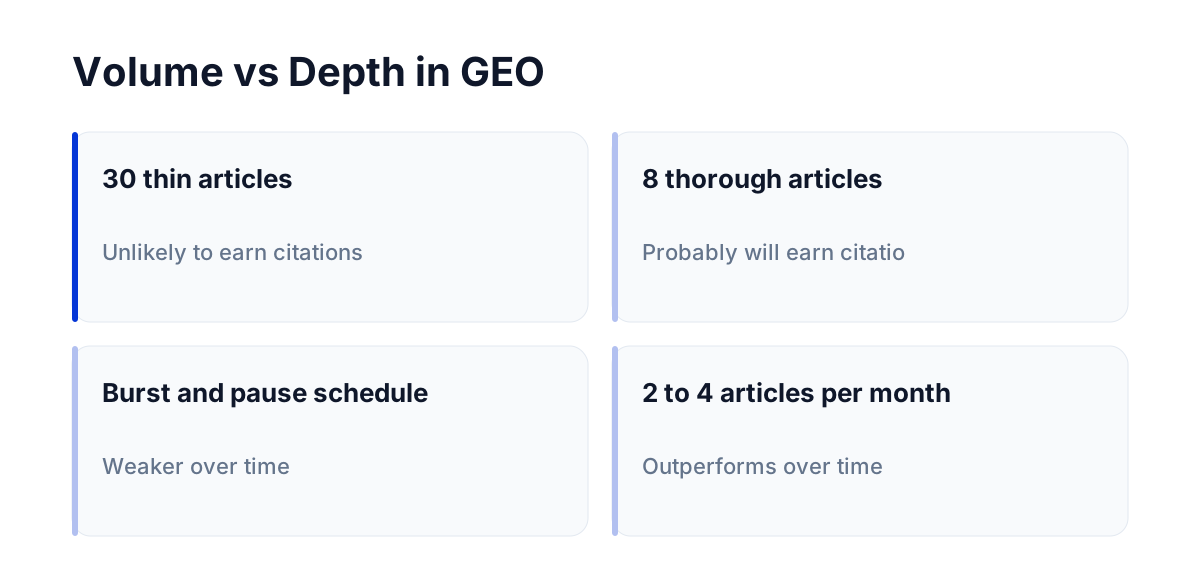
Freshness still matters. A topic cluster that was last updated a year ago competes poorly against one that is actively maintained. Consistent publishing, even at a modest pace of two to four articles per month, outperforms burst-and-pause schedules over time.
What to Look for in Generative Engine Optimization GEO Services
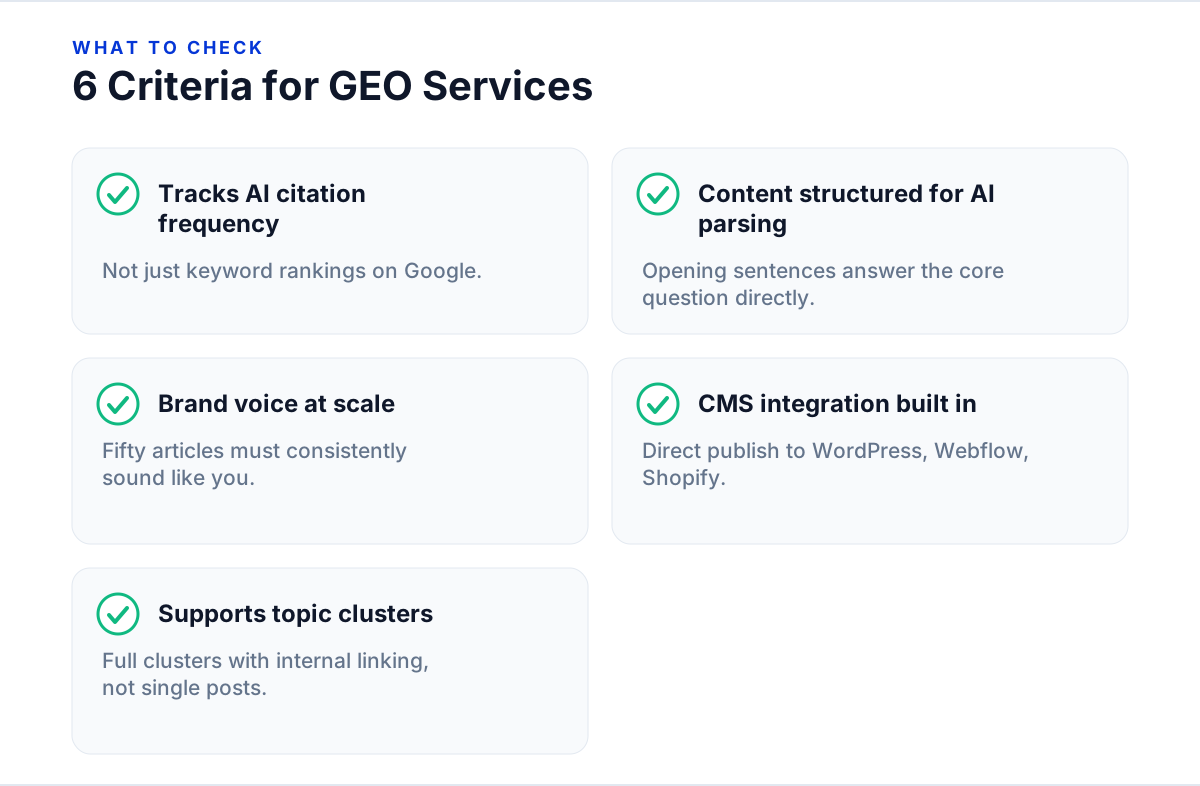
Whether you are evaluating a tool, a platform, or an agency, use these criteria:
1. Does it measure AI citation frequency?
Any serious GEO service should track whether your content is actually being cited by AI tools, not just how it ranks on Google. If the reporting stops at keyword rankings, you are buying SEO with a GEO sticker on it.
2. Does it produce content structured for AI parsing?
Ask for a sample article. Check whether the opening sentences answer the core question directly. Check whether headings are descriptive and specific. Check whether the content could be quoted in a one-sentence answer. Generic listicles fail this test.
3. Can it maintain your brand voice at scale?
One article that sounds like you is easy. Fifty articles that consistently sound like you is the hard part. Ask specifically how brand voice is enforced across a large content library.
4. Does it integrate with your publishing workflow?
A GEO service that produces Word documents you have to manually upload is adding friction, not removing it. Look for direct CMS integrations (WordPress, Webflow, Shopify, and similar) so content can move from generation to publication without bottlenecks.
5. Does it support content clusters, not just individual posts?
Single articles rarely build topical authority. Ask whether the service helps you plan and execute full topic clusters, with internal linking built in.
6. What does the workflow look like for a small team?
Founders and lean content teams cannot manage a ten-step review process. The right service should reduce the work required to publish consistently, not add a new layer of complexity.
Common Mistakes When Buying GEO Services
A few patterns to avoid:
Buying AI generation without AI optimization. Generating articles quickly is not GEO. The content still has to be structured, factually grounded, and written for citability.
Treating GEO and SEO as separate budgets. The best content investments work for both. You do not need two separate content programs.
Optimizing for volume over depth. Publishing 30 thin articles will not earn AI citations. Publishing 8 thorough ones probably will.
Ignoring measurement. If you cannot see whether AI tools are citing your content, you cannot improve. Make sure your tooling gives you that visibility.
How to Evaluate a GEO Service Before You Commit
Before signing anything, run this quick checklist:
1. Ask for two or three sample articles on topics similar to yours. Read the opening paragraph of each. Does it answer a question directly and quotably?
2. Check the reporting demo. Does it show AI citation tracking or only traditional rankings?
3. Ask how brand voice is maintained across a large volume of content.
4. Confirm which CMS platforms it integrates with.
5. Ask how the service handles topic clusters and internal linking.
6. Find out what the minimum viable workflow looks like for a team of one or two people.
If a vendor struggles to answer any of these concretely, that tells you something.
---
Choosing the right generative engine optimization GEO service comes down to one question: does it actually help you get cited by AI, or does it just help you publish faster? The former requires structural content decisions, topical authority building, brand voice consistency, and proper measurement. Start with that standard, and you will filter out most of the noise quickly.
FAQ
What is generative engine optimization GEO?
Generative engine optimization (GEO) is the practice of creating and structuring content so that AI answer engines, such as ChatGPT, Claude, and Gemini, cite it when responding to user queries. It differs from traditional SEO in that the goal is not just to rank in search results but to be quoted or referenced directly inside AI-generated answers.
What is GEO optimization?
GEO optimization refers to the specific techniques used to make content more citable by AI models: writing direct, quotable opening sentences, using descriptive headings, building topical authority through content clusters, and maintaining factual accuracy and consistent brand voice across a content library. It works alongside traditional SEO rather than replacing it.