What Is a Yoast SEO Score and How Do You Improve It?
The Yoast SEO score is a real-time readability and on-page optimization signal built into the Yoast plugin for WordPress. It tells you, at a glance, whe...
 Written by Vladimiros Mykogian
- What the Yoast SEO Score Actually Measures
- Not every Yoast check carries equal weight for actual rankings.
- These two placements have a direct influence on how Google reads your page's topic.
- Yoast flags both under-use (below roughly 0.5%) and over-use (above roughly 3%).
The Yoast SEO score is a real-time readability and on-page optimization signal built into the Yoast plugin for WordPress. It tells you, at a glance, whether a specific piece of content meets a checklist of SEO fundamentals before you hit publish. A green bullet means you have covered the basics. Red or orange means there are concrete gaps holding the page back. The score is a helpful starting point, not a ranking guarantee. Understanding what it actually measures, and what it misses, is the difference between chasing a green light and building content that genuinely ranks.
What the Yoast SEO Score Actually Measures
Yoast runs two parallel analyses on every post or page:
SEO analysis: checks whether your focus keyphrase appears in the right places (title, meta description, first paragraph, subheadings, image alt text, URL slug) and whether the page has enough internal and outbound links.
Readability analysis: checks sentence length, paragraph length, use of transition words, passive voice percentage, and whether subheadings are distributed evenly through the content.
Each check returns one of three signals: green (good), orange (needs improvement), or red (problem). The overall bullet color reflects the weakest signals in the set. A single red check can drag an otherwise solid page down to orange.
The Checks That Matter Most
Not every Yoast check carries equal weight for actual rankings. Focus your energy here:
Keyphrase in Title and Meta Description
These two placements have a direct influence on how Google reads your page's topic. The keyphrase should appear naturally near the start of the title tag, not buried at the end.
Keyphrase Density and Distribution
Yoast flags both under-use (below roughly 0.5%) and over-use (above roughly 3%). More practically, the keyphrase should appear in the opening paragraph and at least one subheading. Forcing it into every other sentence is a red flag to both Yoast and Google.
Internal Links
Yoast requires at least one internal link per post. In practice, aim for two to four contextual links pointing to related content on your site. This builds topical clusters and passes authority between pages, which matters far more than the green checkmark itself. If you are still building out your content cluster, linking to your site's cornerstone content is a good default starting point.
Outbound Links
At least one link to a credible external source is recommended. This is a signal of thoroughness, not a traffic drain. For example, Google's own Search Central documentation on how Google reads title links is the kind of primary source worth citing when you discuss title tag best practices. Link to primary sources where you can.
Content Length
Yoast starts showing a green signal around 300 words for standard posts. That is a very low bar. For competitive keywords, 800 to 1,500 words of dense, useful content is a more realistic floor.
What the Yoast Score Does NOT Tell You
This is where a lot of small teams waste time chasing the wrong signal:
It does not measure topical authority. A green score on a thin page competing against a site with 40 deeply interlinked articles on the same topic will not help you rank.
It does not evaluate content quality or accuracy. You can score green with repetitive, unhelpful content.
It does not check search intent match. If the page format does not match what the searcher expects (a list vs. a guide vs. a product page), rankings will suffer regardless of the score.
It does not assess page speed, Core Web Vitals, or backlinks. All of these influence rankings and none of them appear in the Yoast panel.
Think of the Yoast score as a pre-flight checklist, not a flight path. Clearing the checklist is necessary, not sufficient.
A Step-by-Step Process to Hit Green Before Publishing
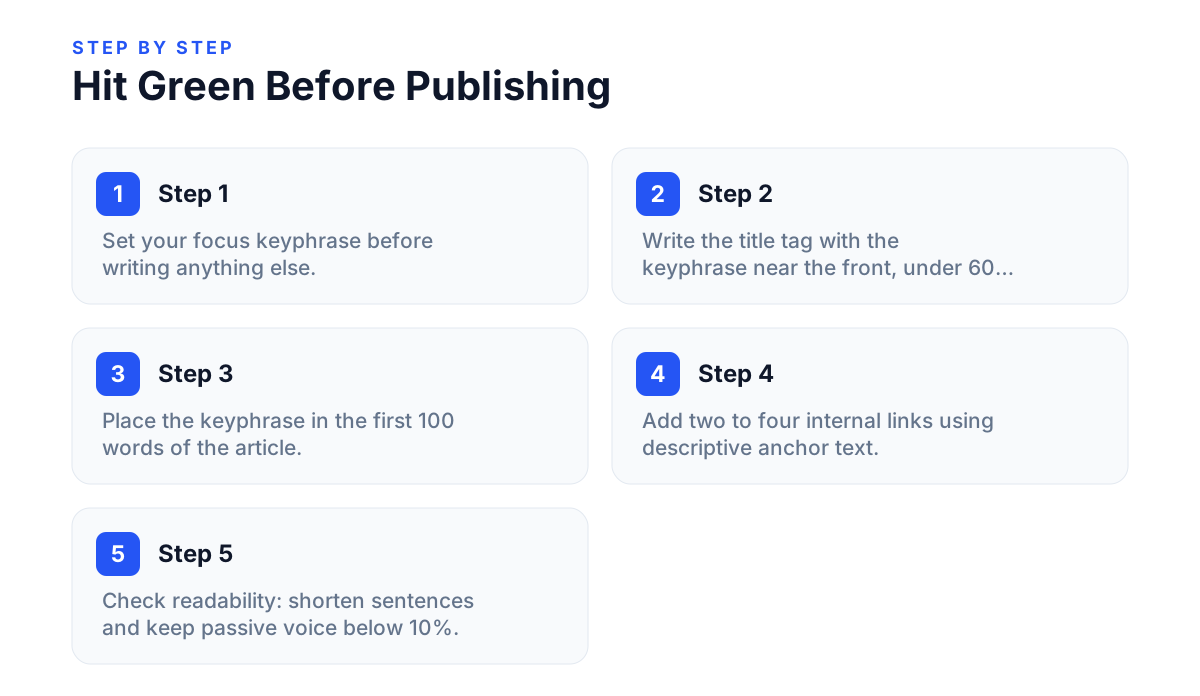
Follow this sequence on every article and you will rarely leave a red check behind:
1. Set your focus keyphrase first. Enter the exact phrase you are targeting before you write anything else. Let it anchor your title, slug, and opening paragraph.
2. Write the title tag with the keyphrase near the front. Keep it under 60 characters so it does not get truncated in search results.
3. Write the meta description as a one-sentence answer. Include the keyphrase naturally and keep it under 155 characters.
4. Place the keyphrase in the first 100 words. The opening paragraph should answer the core question directly. This also helps AI answer engines lift your content as a citation.
5. Use the keyphrase in at least one H2 or H3. Do not force it. If no subheading naturally fits, rephrase the heading so it does.
6. Add alt text to every image. Describe the image accurately and include the keyphrase if it fits without sounding awkward.
7. Add internal links before hitting publish. Link to two to four related posts or pages on your site using descriptive anchor text.
8. Add at least one outbound link to a credible source. Point to official documentation, reputable research, or a well-known reference that supports a specific claim in the article.
9. Check the readability tab. Shorten any sentences flagged as too long. Break up paragraphs over three lines. Aim to keep passive voice below 10% of sentences.
Common Mistakes That Keep You on Orange
Changing the keyphrase after writing. If you set the focus keyphrase after drafting, the content often does not reflect it naturally, and Yoast flags the distribution as poor.
Ignoring the slug. Yoast checks whether the keyphrase appears in the URL. A slug like /post-12345/ will always fail this check. Use a readable, keyphrase-containing slug from the start.
Using the keyphrase in only the exact singular or plural form. Yoast does handle basic morphological variants, but synonyms and related phrases will not satisfy the keyphrase density check. Be deliberate about using the exact focus keyphrase in the right locations.
Treating orange as "close enough." Orange checks often point to real gaps: missing internal links, no keyphrase in the meta description, or zero subheadings. These are quick fixes that take less than five minutes.
Skipping outbound links. Many writers add internal links but forget external ones entirely. Yoast flags the absence of an outbound link, and more importantly, citing a credible source strengthens the credibility of the page for readers and AI answer engines alike.
Yoast Score vs. Real-World Ranking Signals
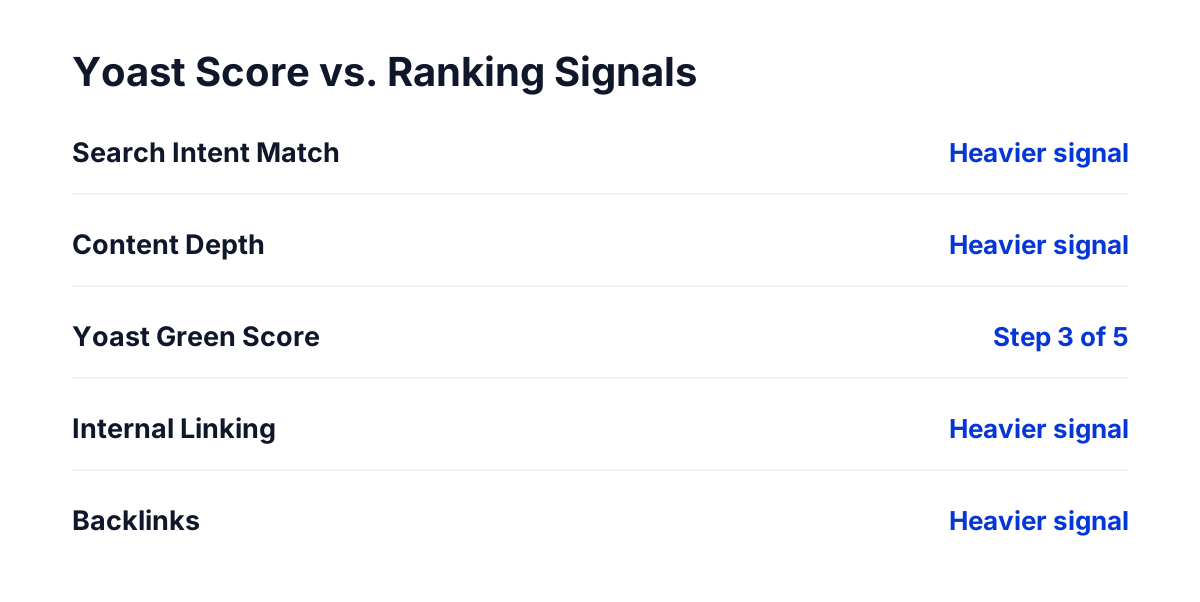
A green Yoast score means your on-page fundamentals are covered. The heavier ranking factors are off-page: backlinks, topical authority, and how well your content cluster signals expertise to Google.
For small teams and SaaS companies publishing consistently, the smarter priority stack looks like this:
1. Search intent match (is this the right format for this keyword?)
2. Content depth and usefulness (does this actually answer the question better than the current top results?)
3. Yoast green (are the on-page basics covered?)
4. Internal linking and cluster structure (does this post connect to related content?)
5. Promotion and link acquisition (are other credible sites pointing here?)
The Yoast score belongs at step three. Getting there should take five to ten minutes per post, not be the primary focus of your writing time.
FAQ
Does a green Yoast score guarantee a first-page ranking?
No. The score confirms on-page basics are in place. Rankings also depend on content quality, search intent match, topical authority, backlinks, and technical site health. None of those are reflected in the Yoast score.
What is the minimum content length Yoast recommends?
Yoast turns green at around 300 words, but that threshold is far below what most competitive keywords require. For informational articles targeting real search traffic, aim for at least 800 to 1,000 words of substantive content.
Should I set a focus keyphrase for every post?
Yes, every indexed post should have a focus keyphrase. If you cannot identify one specific phrase the post is targeting, that is a signal the content strategy for that post needs to be clarified before publishing.
Can I use the same focus keyphrase on multiple posts?
Yoast will warn you if you reuse a keyphrase across posts (keyphrase cannibalization). Each post should target a distinct primary phrase. Related posts can target closely related variants, but the focus terms should not overlap exactly.
---
The Yoast SEO score is a practical, fast-to-use quality gate. Use it to catch the basics before every publish, then invest your real energy in content depth, search intent, and building a consistent publishing cadence. A green bullet on a thin post will not move the needle. A green bullet on a genuinely useful, well-structured article, one with real outbound citations and a tight internal linking structure, is a solid foundation for ranking.