Agentic Search Optimization: A Guide for Small Business SEO
Agentic search optimization (ASO) is the practice of structuring your content so that AI agents, not just human users, can find, evaluate, and act on it...
 Written by Vladimiros Mykogian
- Traditional search is a human typing a query, scanning results, and clicking a link.
- Here's the counterintuitive truth: small businesses with tight topic focus have a real advantage in agentic search.
- The Four Pillars of Agentic Search Optimization
- Every page should answer its core question in the first two to three sentences, before any context-setting or storytelling.
Agentic search optimization (ASO) is the practice of structuring your content so that AI agents, not just human users, can find, evaluate, and act on it autonomously. In 2026, AI agents book appointments, compare vendors, and surface recommendations without a human ever typing a query into a search bar. If your content isn't built for that workflow, you're invisible to a growing slice of your potential audience. This is not a distant future problem. It's happening now, and small businesses that adapt early will own positions that are much harder to dislodge later.
What "Agentic Search" Actually Means
Traditional search is a human typing a query, scanning results, and clicking a link. Agentic search is an AI system executing a multi-step task on behalf of a user. The agent might need to find a reliable project management tool, compare three options, read their pricing pages, and return a shortlist, all without human intervention at each step.
That changes what "ranking" means. The agent isn't looking at a blue link on a results page. It's parsing structured content, extracting facts, and deciding whether your brand is credible enough to include in its answer or recommendation.
Three things drive that decision:
Factual density: Does your content contain clear, verifiable claims the agent can extract?
Source authority: Does your domain have enough trust signals for the agent to cite you without hesitation?
Structured clarity: Is your content organized in a way a machine can parse quickly, with headings, definitions, and direct answers near the top?
Why Small Businesses Are Actually Well-Positioned
Here's the counterintuitive truth: small businesses with tight topic focus have a real advantage in agentic search. A 50-page site that covers one niche with depth and consistency is easier for an AI agent to trust than a 5,000-page site covering everything loosely.
Topical authority, the idea that your site is the go-to source on a narrow subject, matters more in agentic search than in classic SEO. Agents are trained to prefer sources that demonstrate consistent expertise. A small SaaS team that publishes 3 to 4 genuinely useful articles per month on a specific problem space will out-cite a generalist blog publishing 20 thin posts.
The bar is: be the clearest, most complete source on your topic. Not the biggest.
The Four Pillars of Agentic Search Optimization
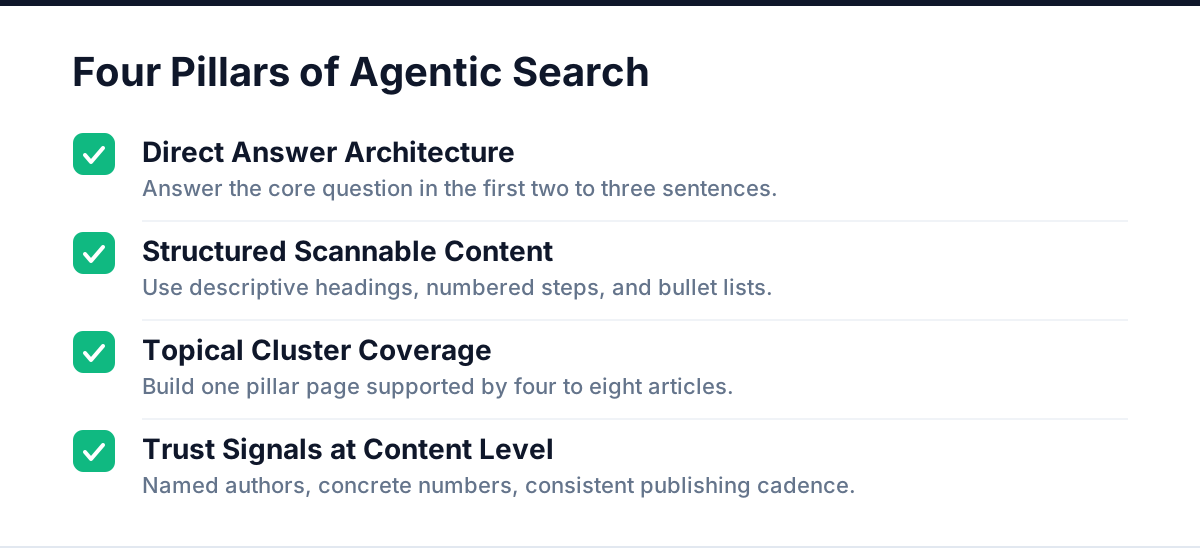
1. Direct Answer Architecture
Every page should answer its core question in the first two to three sentences, before any context-setting or storytelling. Agents lift the most quotable, precise answer they can find. If your answer is buried in paragraph six, the agent moves on.
Concretely: write your intro the way a senior analyst would brief a CEO. Lead with the answer, then support it.
2. Structured, Scannable Content
Use descriptive H2 and H3 headings that state what the section covers, not clever wordplay. Include numbered steps when there's a sequence. Use short bullet lists for comparisons or feature sets. Add a FAQ section at the bottom of every article targeting "people also ask" territory.
Agents parse headings to build a document map before reading the full text. If your structure is flat or vague, you're harder to cite accurately.
3. Topical Cluster Coverage
One great article is not enough. Agents cross-reference. If they find your pillar page on a topic but nothing else on your domain supports it, your credibility score drops.
Build clusters: one comprehensive pillar page, supported by four to eight specific supporting articles that each link back to the pillar. A small business selling accounting software might have a pillar on "cash flow management for freelancers" supported by articles on invoicing cadence, expense tracking, tax prep timelines, and late payment handling.
Each supporting article reinforces that you own this topic space. That's what pushes you into agent recommendations. For a deeper look at building this kind of architecture, see our guide to content clusters and topical authority for lean teams.
4. Trust Signals at the Content Level
Classic SEO trust signals (backlinks, domain age) still matter. But agentic search adds a layer: in-content trust signals. These include:
Named authors with clear credentials or a consistent byline
Specific claims with concrete numbers (not vague generalities)
Regular publishing cadence that shows the site is actively maintained
Consistent brand voice that signals a real organization, not a content farm
An AI agent evaluating two articles on the same topic will favor the one that reads like a knowledgeable practitioner wrote it, not the one padded with filler sentences.
How This Changes Your Content Calendar
Agentic search optimization rewards volume and consistency more than occasional home runs. A single viral post does nothing for you if there's no content ecosystem around it.
Practical implications for a small team:
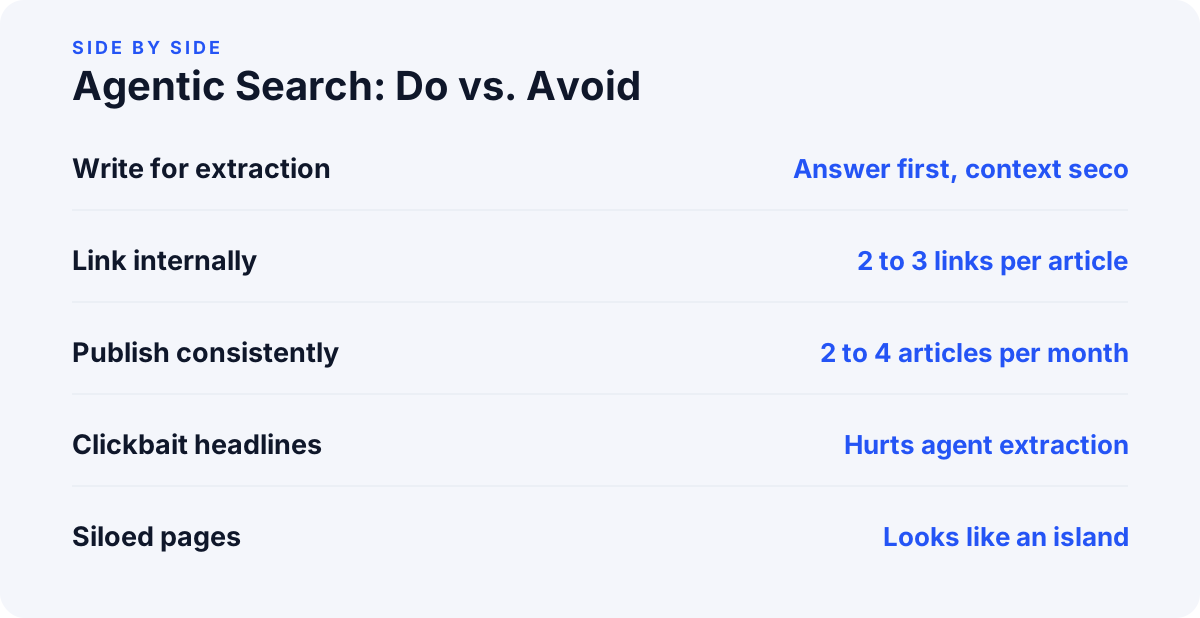
Publish on a schedule. Two to four articles per month, consistently, beats eight articles in January and nothing until May.
Prioritize depth over breadth. Cover your core topic exhaustively before expanding to adjacent areas.
Update existing content. Agents check recency. A post last updated two or three years ago signals an abandoned site. Review and refresh your top pages at least once a year.
Write for entities, not just keywords. Agentic systems think in terms of concepts and relationships, not exact-match phrases. Use the natural vocabulary of your topic, including synonyms, related concepts, and specific examples.
Measuring Whether Agentic Optimization Is Working
You can't track "agent impressions" directly yet, but you can track proxy signals:
AI citation tracking: Manually prompt AI answer engines with questions in your niche and see if your site gets cited. Do this monthly.
Branded search volume: When agents recommend you, users follow up with branded searches. A rising branded query trend is a strong signal.
Organic traffic from informational queries: Agentic content tends to rank for long-tail, question-based queries. Watch this segment in your analytics.
Keyword ranking velocity: Content built for agentic search, with clear structure and factual density, tends to rank faster on Google too, because the two goals are more aligned than opposed.
The baseline recommendation: set up a simple monthly check across all four signals. You don't need a complex reporting stack. A spreadsheet and 30 minutes per month is enough to see the trend. Google Search Console is the right starting point for tracking organic query trends and branded search growth at no cost.
Common Mistakes to Avoid
Optimizing for clicks instead of answers. Clickbait headlines and teaser intros hurt you in agentic search because the agent can't extract a clear answer. Write for extraction first.
Ignoring internal linking. Every article should link to at least two or three related articles on your site. Agents follow internal links to verify your topical depth. A page with no internal links looks like an island.
Publishing inconsistently. A site with 40 articles from three years ago and nothing recent looks dormant to an agent. Recency signals active maintenance and relevance.
Treating GEO and SEO as separate strategies. They're not. Content that answers questions clearly, is structured logically, and is published consistently ranks on Google AND gets cited by AI engines. Optimize once, win twice.
FAQ
What is the difference between agentic search optimization and traditional SEO?
Traditional SEO focuses on ranking in human-facing search results. Agentic search optimization focuses on making your content parseable, trustworthy, and citable by AI agents executing tasks autonomously. The tactics overlap significantly, but agentic search puts more weight on direct answers, topical depth, and in-content trust signals.
Do small businesses need a big content budget to compete in agentic search?
No. A consistent cadence of two to four well-structured, genuinely useful articles per month, focused on a narrow topic, is more effective than a large volume of thin content. Small teams with tight focus have a real structural advantage.
How quickly will agentic search affect my organic traffic?
The shift is already underway in 2026. Sites optimized for AI citation are seeing measurable branded search lift and informational traffic gains within three to six months of consistent publishing. The earlier you start, the harder your position is to dislodge.
Should I change my existing content or start fresh?
Start with a content audit. Identify your top 10 existing pages and update them first: add a direct-answer intro, improve heading structure, add a FAQ section, and refresh any outdated information. Then build new content around clusters. Updating strong existing pages often delivers faster gains than creating entirely new ones.
---
Agentic search isn't a trend to watch. It's a shift to act on now. The good news is that the fundamentals, clear answers, deep topical coverage, consistent publishing, and genuine expertise, are the same ones that have always separated content that works from content that collects dust. Start there, and you'll be building for the next three years of search, not just the last three.