Generative Engine Optimization Services: A Practical Guide
If you want your brand to appear when someone asks ChatGPT or Gemini a question in your category, you need generative engine optimization services. GEO...
 Written by Vladimiros Mykogian
- When a user asks an AI assistant a question, the model synthesizes an answer from its training data and, increasingly, from live retrieval.
- GEO services combine content strategy, writing, and technical optimization with a specific goal: making your content the most citable answer to the questions your buyers are asking.
- AI models favor content that is clearly organized and makes one strong claim per section.
- A single article rarely gets cited. AI models trust brands that cover a topic completely.
If you want your brand to appear when someone asks ChatGPT or Gemini a question in your category, you need generative engine optimization services. GEO is the discipline of structuring, writing, and distributing content so that AI answer engines treat your brand as a credible, citable source. It is not the same as traditional SEO, and the gap between brands that understand this and those that do not is widening fast.
What "Getting Cited" Actually Means in 2026
When a user asks an AI assistant a question, the model synthesizes an answer from its training data and, increasingly, from live retrieval. Your content either gets pulled into that answer or it does not. There is no page two, no second chance, no ad slot to buy your way in.
Getting cited means the model surfaces your brand, your framing, or your specific claim in its response. That can look like:
A direct name-drop ("According to [your brand]...")
Your category definition being used verbatim
Your structured how-to steps being paraphrased in the answer
Your FAQ content matching the query and getting retrieved
The brands that show up consistently share a few traits: they publish authoritative, well-structured content at volume, they cover a topic end-to-end (topical authority), and their writing is direct and quotable rather than vague and hedged.
What Generative Engine Optimization Services Actually Do
GEO services combine content strategy, writing, and technical optimization with a specific goal: making your content the most citable answer to the questions your buyers are asking. In practice, that breaks down into four areas.
1. Structuring Content for AI Retrieval
AI models favor content that is clearly organized and makes one strong claim per section. That means:
Leading each article with a direct, two-to-three sentence answer to the core question
Using descriptive H2 and H3 headings that mirror how questions are phrased
Writing short paragraphs with concrete specifics rather than long blocks of general prose
Including definitions, numbered steps, and comparison criteria that an AI can lift cleanly
Vague, hedge-everything content is essentially invisible to generative engines. They cannot summarize what you have not said clearly.
3. Maintaining Brand Voice Consistency
AI citation is not just about showing up; it is about showing up as recognizably you. If your content sounds like ten different writers (or like generic AI output), models have a harder time associating a coherent point of view with your brand. Consistent tone, consistent terminology, and consistent framing across dozens of articles compound into a recognizable signal.
4. Measuring Citation Frequency Alongside Rankings
Traditional SEO tracks keyword rankings and organic traffic. GEO adds a third metric: how often and in what context AI engines surface your brand. That means running structured queries in ChatGPT, Gemini, Claude, and Perplexity on a regular cadence, tracking which questions pull your content, and iterating based on what you find. If you are not measuring it, you are not optimizing it.
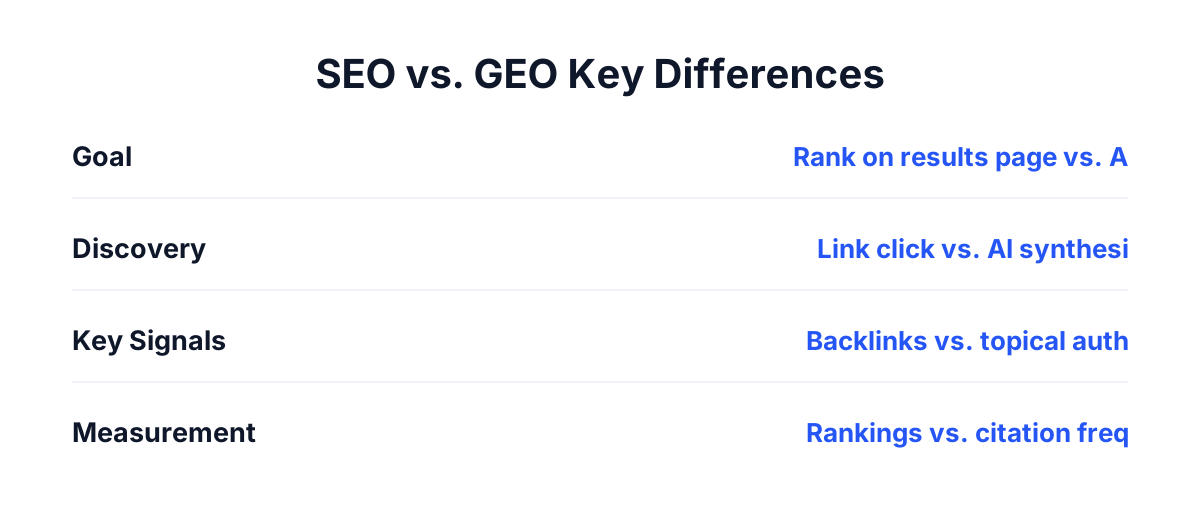
SEO vs. GEO: Where They Overlap and Where They Differ
SEO and GEO are not the same discipline, but they are not separate silos either.
| Dimension | Traditional SEO | Generative Engine Optimization |
|---|---|---|
| Goal | Rank on a results page | Get cited in an AI-generated answer |
| Discovery mechanism | User clicks a link | AI synthesizes your content into a response |
| Key signals | Backlinks, on-page optimization, Core Web Vitals | Topical authority, content clarity, structured answers |
| Content format | Works with many formats | Strongly favors direct, quotable, well-structured prose |
| Measurement | Rankings and traffic | Citation frequency plus rankings |
The good news: content optimized well for GEO tends to also rank well organically, because the traits that make content citable (clarity, authority, structure) are the same traits Google rewards. Optimizing for both is not twice the work; it is the same work done with the right framework. Google's own Search Central documentation on content quality reinforces many of the same principles: demonstrate expertise, answer questions directly, and structure content so it is easy to parse.
How Small Teams Can Compete
The brands most likely to dominate AI citations in a given category are not always the largest. They are the ones publishing consistently, covering their topic completely, and writing in a way that is clear enough to quote.
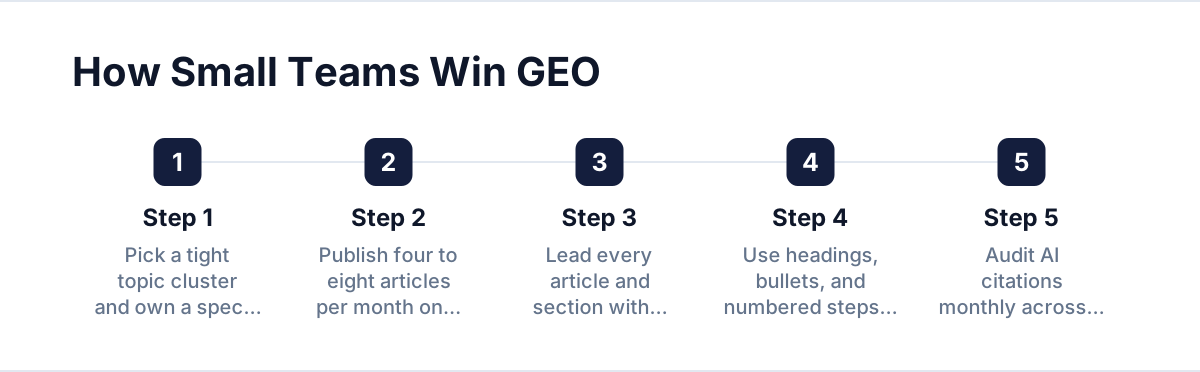
For a small SaaS team or founder-led business, that means:
1. Pick a tight topic cluster. Do not try to cover everything. Own a specific corner of your category deeply before expanding.
2. Publish on a reliable cadence. Sporadic publishing builds no authority. A consistent schedule of four to eight articles per month compounds over time.
3. Lead with the answer. Every article, every section. State the point, then explain it. Never bury the lead.
4. Use real structure. Headings, bullets, numbered steps, and short paragraphs are not just stylistic choices; they are retrieval signals.
5. Audit your AI citations monthly. Run 10 to 20 target queries in major AI assistants. Track what comes up and what does not. Adjust your content gaps accordingly.
The operational bottleneck is almost always production, not strategy. Most teams know what they should publish; they just cannot produce it consistently at the quality and volume that GEO requires.
FAQ
What is generative engine optimization (GEO)?
Generative engine optimization (GEO) is the practice of creating and structuring content so that AI answer engines like ChatGPT, Gemini, and Claude cite your brand in their responses. Where traditional SEO targets a position on a search results page, GEO targets inclusion in an AI-generated answer. The core tactics are building topical authority, writing with direct and quotable clarity, and measuring citation frequency over time.
What is GEO optimization?
GEO optimization refers to the specific actions taken to improve how often and how prominently an AI engine surfaces your content. That includes structuring articles with clear direct answers, publishing content clusters that cover a topic end-to-end, maintaining consistent brand voice, and iterating based on regular citation audits across major AI assistants.
---
The brands that win AI citations in their categories are not waiting for the landscape to settle. They are publishing clear, authoritative, well-structured content now and measuring the results. If your team does not have the bandwidth to produce that volume without sacrificing quality, building a system around it is the most leveraged thing you can do this year.