AI Workflow Automation for SEO Content at Scale
AI workflow automation lets small teams publish SEO-optimized blog content at scale by replacing manual writing, scheduling, and publishing steps with c...
 Written by Vladimiros Mykogian
- A lot of people hear "AI workflow automation" and picture a single tool that magically writes great blog posts.
- Publishing one high-quality, well-optimized blog post per week manually takes roughly 4 to 8 hours of skilled work: research, writing, editing, SEO formatting, uploading, and scheduling.
- The most common failure point in AI content automation is brand voice.
- Automation amplifies whatever strategy you feed into it.
AI workflow automation lets small teams publish SEO-optimized blog content at scale by replacing manual writing, scheduling, and publishing steps with connected, automated processes. If you are a founder or content manager trying to grow organic traffic without hiring a team of writers, this is the approach that makes it possible. Here is exactly how it works and how to set it up.
What "AI Workflow Automation" Actually Means for Content
A lot of people hear "AI workflow automation" and picture a single tool that magically writes great blog posts. That is not quite right. A real automation workflow chains several steps together so that human judgment is applied once, at the strategy level, and the repetitive execution happens automatically.
For SEO content, that chain typically looks like this:
1. Keyword input - you identify a target keyword and intent
2. Brief generation - the system builds a structured outline based on your topic cluster and brand voice
3. Content generation - AI drafts the article, matched to your voice and SEO requirements
4. On-page optimization - headings, meta description, internal links, and readability are scored and adjusted
5. Scheduling - the article is queued into your publishing calendar
6. Auto-publishing - the post goes live on your CMS (WordPress, Webflow, Shopify, etc.) at the scheduled time
Remove any one of those steps from the automation and you reintroduce manual bottlenecks. The goal is a pipeline where your only recurring input is keyword and topic decisions.
Why Small Teams Cannot Win With Manual Content Production
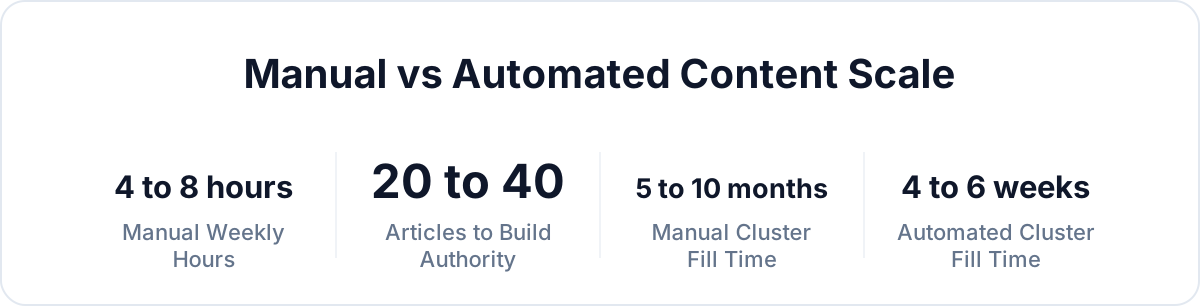
Publishing one high-quality, well-optimized blog post per week manually takes roughly 4 to 8 hours of skilled work: research, writing, editing, SEO formatting, uploading, and scheduling. For a lean SaaS team or small business, that is a significant portion of someone's week, every week, indefinitely.
Topical authority (the thing that actually moves rankings) requires consistent coverage of a topic cluster. Google rewards sites that publish a broad, deep set of related content, not one-off posts. To build authority in a niche, most sites need at least 20 to 40 well-targeted articles covering a cluster before they see meaningful ranking momentum.
At one manual post per week, that is 5 to 10 months before the cluster is even filled in. With an automated workflow publishing three to five posts per week, you can fill that cluster in 4 to 6 weeks.
The math is not subtle. Automation is not a shortcut. It is the only realistic way for a small team to compete with larger content operations.
The Non-Negotiable: Brand Voice Must Be Baked In
The most common failure point in AI content automation is brand voice. Generic AI output sounds like it was written by a committee. Readers notice. More importantly, it does not build trust with the audience you are trying to convert.
Brand voice in an automated workflow is not an afterthought. It has to be defined and enforced at the generation step. This means your automation system needs to work from a documented voice profile, covering:
Tone descriptors: are you direct and plainspoken, or conversational and warm?
Structural preferences: do you lead with the answer, or build to it?
Vocabulary rules: words or phrases you always use, and ones you never use
Perspective: first-person plural ("we"), second-person ("you"), or authoritative third-person?
When these parameters are embedded into the generation step, every article that comes out of the pipeline reads consistently. That consistency compounds: readers start to recognize the voice, trust builds, and repeat visits increase.
Building a Content Cluster Strategy Before You Automate
Automation amplifies whatever strategy you feed into it. If your keyword list is unfocused, you will publish a lot of content that collectively ranks for nothing. Before you flip on an automated pipeline, spend time on cluster architecture. (For a deeper look at how cluster architecture drives topical authority, see Kedauros's guide to content cluster strategy.)
Choose a Pillar Topic
Pick one broad topic that is central to what your product or service does. For a project management SaaS, that might be "team productivity." For an HR platform, it might be "employee onboarding."
Map Supporting Keywords
Use keyword research to find 20 to 40 specific, lower-competition queries that sit under that pillar. These become your individual article targets. Look for keywords with clear informational or commercial intent, manageable difficulty scores, and genuine relevance to your buyer's journey.
Sequence Your Publishing Order
Publish the pillar article first, then fill in supporting cluster articles that link back to it. This gives Google a clear topical map of your site from the start, rather than a scattered set of posts that do not reinforce each other.
Once that architecture is defined, you hand it to the automation workflow and let it execute.
Optimizing AI-Generated Content for Both Google and AI Answer Engines
In 2026, ranking on Google is only half the content objective. AI answer engines like ChatGPT, Claude, and Gemini are now answering millions of queries directly, and they pull from published web content to do it. Getting cited by those engines is a real traffic and brand awareness channel. This approach is called Generative Engine Optimization (GEO), and it changes how you structure automated content.
For Google, the fundamentals still apply: target keyword in title, clear heading structure, sufficient depth, internal links, and fast page load. Google's own Search Central documentation frames this around content that is genuinely helpful and written for people first, a standard that well-structured automated content can absolutely meet.
For AI engines, the structural requirements overlap but add a few specifics:
Direct answers early: the first 2 to 3 sentences of any section should be quotable on their own. AI engines prefer to lift clean, self-contained statements.
FAQ sections: questions and short answers are heavily cited by AI engines. Every article in your automated pipeline should end with a FAQ block.
Factual specificity: vague, hedged language is rarely cited. Concrete, declarative statements are.
Consistent entity signals: use your brand name, product category, and core topic consistently so that AI engines associate your content with the relevant query space.
An automated workflow that is built with GEO in mind produces content that works on both surfaces without requiring a second round of edits.
Measuring What Your Automated Pipeline Is Actually Delivering
Automation without measurement is just publishing into a void. Set up a simple reporting layer from day one.
Metrics that matter:
Keyword rankings: track position for each target keyword weekly. Expect movement in 6 to 12 weeks for new content on an established domain, longer for newer sites.
Organic sessions: monthly organic traffic per published article. A healthy article in a real cluster should be contributing sessions within 3 months.
AI citations: monitor whether your content is being referenced in AI engine responses for your target queries. This is an emerging but increasingly important signal.
Publishing cadence: are you actually hitting your scheduled output? Automation should make this 100%, not something you are manually chasing.
If a cluster is not generating ranking movement after 3 months and 15 or more published articles, the issue is usually keyword difficulty (targets are too competitive) or thin content (articles lack the depth to satisfy search intent). Both are fixable at the strategy and generation level, without scrapping the pipeline.
Common Mistakes to Avoid When Setting Up AI Workflow Automation
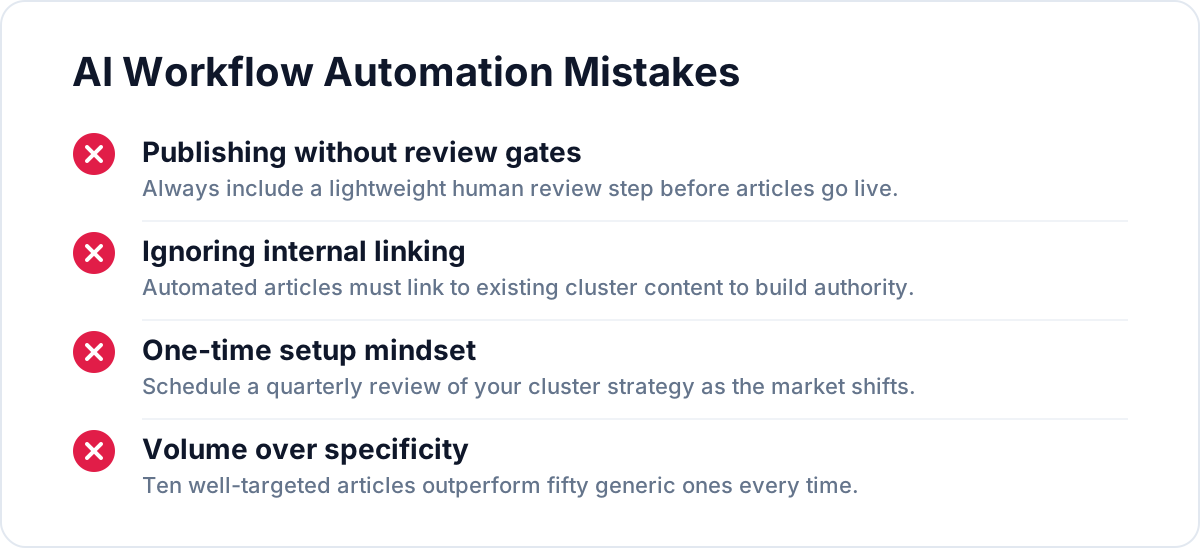
Publishing without review gates. Fully automated does not mean zero human touch. A lightweight review step, even 10 minutes per article, catches factual gaps, off-brand language, or formatting issues before they go live. Build this into your workflow as a scheduled task, not an afterthought.
Ignoring internal linking. Automated articles that do not link to each other undermine the topical authority you are trying to build. Make sure your workflow includes a step where new articles link to existing cluster content.
Treating automation as a one-time setup. Keyword trends shift. New competitors enter your space. Your product evolves. Your content cluster strategy needs a quarterly review, even if the pipeline runs on its own day-to-day.
Prioritizing volume over specificity. Ten highly specific, well-targeted articles will outperform fifty generic ones. Do not let automation tempt you into publishing unfocused content just because it is easy to produce.
---
Conclusion
AI workflow automation is not about removing humans from content strategy. It is about removing humans from the repetitive, time-consuming execution steps so that your strategic judgment can go further. For small business owners and lean SaaS teams, it is the most direct path to consistent organic traffic growth without a writing team or an agency.
Start with a defined content cluster, embed your brand voice at the generation level, publish with both Google and AI engines in mind, and measure results tightly. The pipeline does the rest.
If you are evaluating whether an automated content workflow makes sense for your site, the best next step is to map out one content cluster and estimate how long it would take your current team to fill it manually. That number will tell you everything you need to know.
---
FAQ
How many articles per week should an AI content automation workflow publish?
For most small business and SaaS sites, three to five articles per week is the right target. It is enough to fill a content cluster in 4 to 6 weeks without overwhelming your CMS or review process. Start at two if your review bandwidth is limited and scale from there.
Does AI-generated content rank on Google?
Yes, when it is well-structured, targets a specific keyword with clear intent, and demonstrates genuine topical depth. Google's focus is on content quality and usefulness, not the method of production. Thin or generic AI content does not rank, but that is a quality problem, not an AI problem.
What is the difference between SEO and GEO in an automated content workflow?
SEO (Search Engine Optimization) focuses on ranking in Google and similar search engines. GEO (Generative Engine Optimization) focuses on getting cited by AI answer engines like ChatGPT, Claude, and Gemini. The tactics overlap significantly: clear structure, direct answers, and factual specificity help with both. A well-built automated workflow targets both surfaces simultaneously.
How long before automated content starts driving organic traffic?
On an established domain, expect to see keyword movement in 6 to 12 weeks for new articles. Organic session volume typically follows 2 to 4 weeks after ranking. Brand-new domains take longer, often 4 to 6 months, because domain authority builds gradually regardless of content quality or publishing speed.